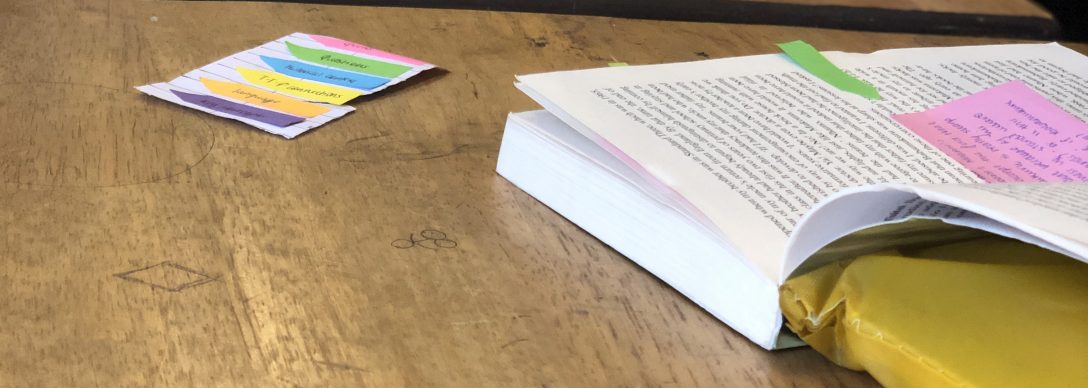
Nancie Atwell’s Naming the World is a poetry anthology for middle school teachers that begins with a chunk titled, “What Poetry Can Do.” Atwell writes, “by the end of this introductory chunk, I hope every student is sold on the potential of poetry to give voice to something in the experience of his or her life,” (p. 2).
By the end of my introductory chunk, I hope, like Atwell, that every student is sold on the power of research.
I love research – I love reading research, I love the process of researching, I love the power of some research papers. Perhaps this is because teenager Sruti wanted to be an investigative journalist. Perhaps because I really found topics I was willing to ‘turn every page’ for. Part of the goal of this set of lessons is to share that enthusiasm with young people, and part of the goal is, like Atwell’s introductory poetry circles, to flood students with interesting, high-quality examples of research that all have power. At the end of this first unit, I ask students to review the readings and their notes from discussion, and answer the question: what can research do?
Their lists look something like this:
what can research do?
Research can…
- scratch in ‘itch’ or satisfy our curiosity (as readers and as researchers)
- prove a claim
- present contrasting views, perspectives, and ideas
- Explore relationships between seemingly unrelated topics that the author suspects are actually related
- Add nuance and detail and specifics to certain topics (like friendship)
- Remove stigma associated with topics by choosing controversial topics and increasing awareness by writing about them publicly
- Promote solutions or treatments that work
- Understand and update information/revise what we know
- Generate new information
- Promote support and provide information to people going through something similar to the research topic
- Bring a change and change the stories we tell about something
- Gather data that is difficult to access, on new topics, to assess impact of something
- Connect two related topics and explore that connection
- Understand social science research
- Change how research can be understood/conducted
I find the papers for this first month or so by reading widely – my assigned readings come from old masters degree syllabi, excerpts from books I am currently reading, research papers related to current events, articles written by academics in nonspecialist publications like the London Review of Books or The New Yorker, or some particularly interesting papers from the bibliographies of previous students’ research reports. Places like Concord Review and Cambridge International also have research papers written by students that can be easier to follow since they are likely to be much shorter and feature simpler language and sentence structure.
A lot of my approach to teaching a researcher’s workshop has been inspired by Atwell’s approach to middle school writing workshop, so I try to flood students with high quality examples of research in a variety of disciplines across a range of lengths and levels of technical language, so that students can really understand the conventions and freedoms of the genre, while also expanding their imaginations around the power of good research.

 sruti teaches
[…] Understanding what research can do? […]
LikeLike